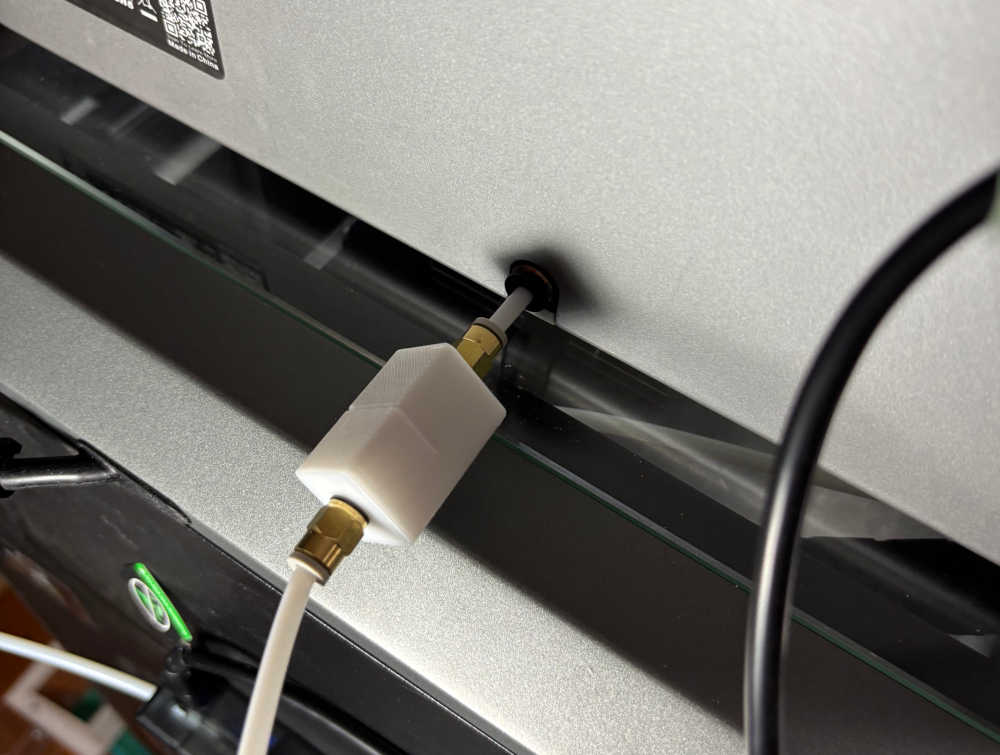
When the filament chokes the inside of the extruder and the CFS tries to retract the filament the whole filament pathway ends up under tension and breaking into it easily is not that easy. I have in the past pulled out the teflon tubing at the back of the CFS until it stretches and exposes some filament and then cut thru that. Yes I know I could remove the extruder and then cut the filament choke point away inside the extruder but I dislike working inside the chamber so was looking to make things easier so have made and inserted a simple filament cutter inline with the teflon tubing at the back of the CFS.
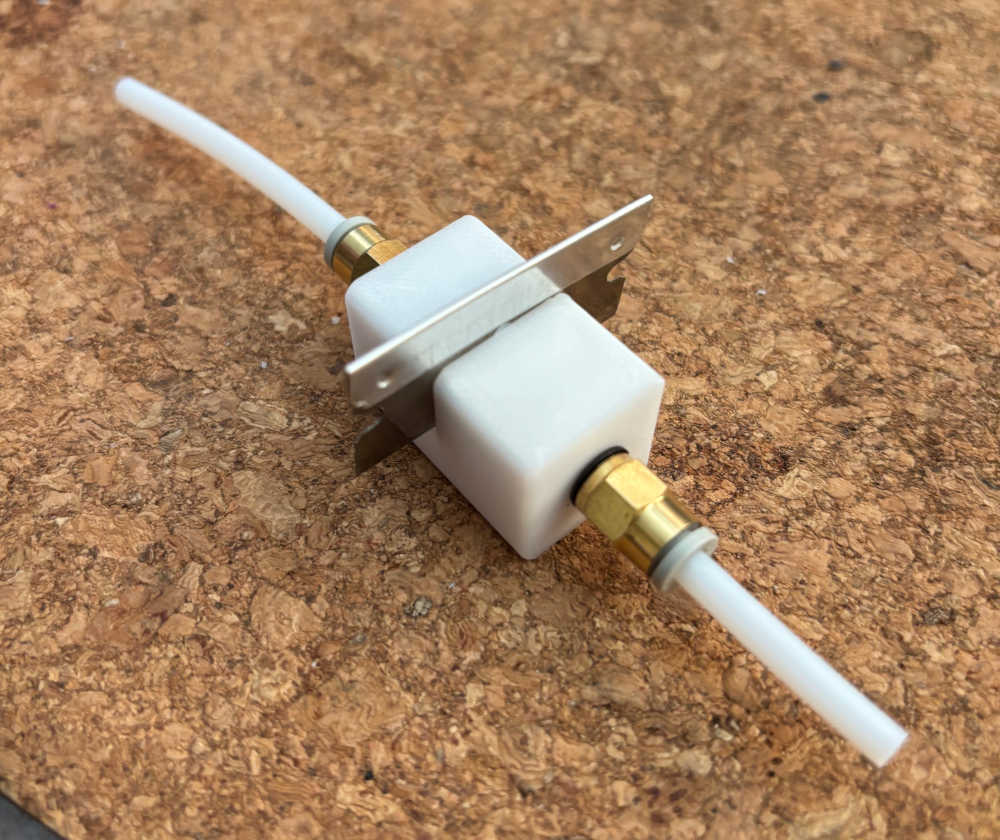
The cutter is a printed block of PETG with two teflon tube fittings screwed into a holes= running through the block and a slot (perpendicular to the hole) just wide enough to fit a razor blade to cut the filament which immediately releases the tension. The remaining filament in between the cut point and the CFS motor is short and thus easy to pull out.
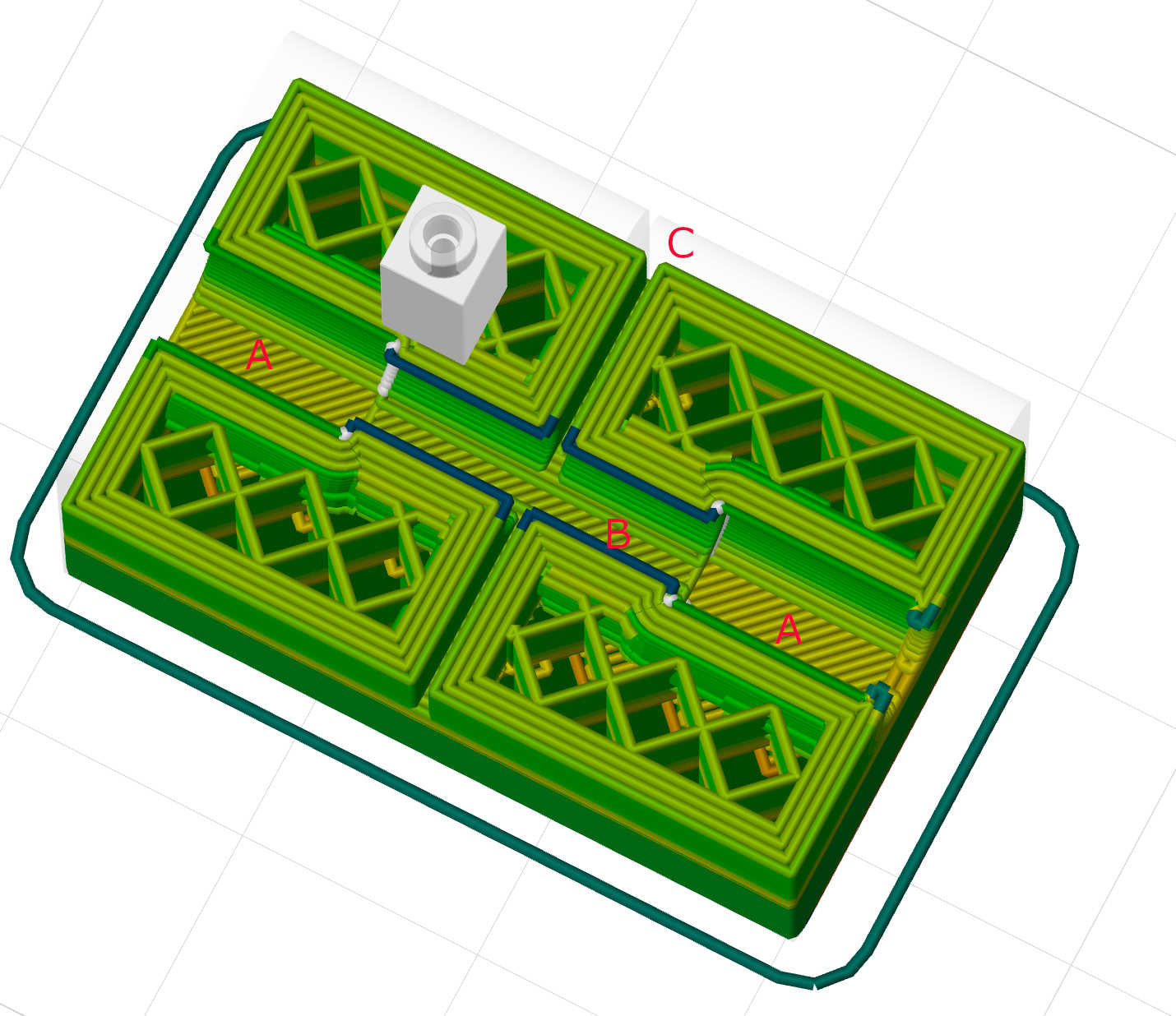
Cross section of cutter shown below. A are 5mm ID holes and threaded using an M6 tap to fit the M6 thread on the fittings. B is 4mm ID which holds a full length section of teflon tubing right up to the backs of each fitting. Then the tubing is cut with the razor blade.
Great layout of your process I’m inspired by the way you displayed the different steps in the slicer and the real installed photo this must have taken some time thank you for sharing
RE . . . must have taken some time, Not really. OpenSCAD programming took about 10 minutes, I printed one prototype (21 mins) to check for filament catching inside the cutter. The first one was without any internal teflon tubing which led me to use the tubing in the second one. I then also printed a spare. So about an hour all up. BTW the brass fittings were from a Bowden upgrade kit so they fit really nicely.
I have been documenting most of my hobbies (wood/metalwork) since 2005, electronics since 2011, and 3DP since 2020. While making things I take many photos and have these organised on my computers by year and then topic and so can find most things very quickly. Have posted 10’s of thousands of posts that include thousands of photos on various forums. Currently helping my son make electric guitars - I 3DP all his rigs and jigs. BTW I have been retired since 2013 so all this is what I have been doing with my retirement
very good idea! I had one failure where there was so much tension on the filament that it kinked the poly tube. It can be a real pain to take the extruder apart when there is that much tension, so I usually try to find some way to unhook the tube. This is a much better solution, and it can be done without increasing the length of the filiment path. Also I think it’s brilliant to just use a slot and a razor blade. When I first saw the name of the project I worried that it was going to be some complex multi part solution, this is the perfect low complexity solution, thanks for sharing.
Thanks drewrt - you’ve describe the same issue well. I usually enjoy solving hobby level woodworking/metalworking/electronics/3DP printing problems and feel like my brain is underutilized unless I have several problems on the go.
Hey Simsy - yeah that is me - still dabbling. Mainly with Electronics and 3Dprinting as I cant stand for too long. Occasionally helping my son with his electric guitars. What are you printing ?