I had been doing 3D modeling and animation with LightWave 3D since the early 90s. Part of what drew me to 3D printers was seeing Creality’s advertisements in the 3D modeling magazines I was reading at the time. The idea of taking something digital and turning it into a physical object felt like science fiction. Back then, 3D printing seemed amazing to me, like a Star Trek replicator creating things out of thin air. Of course, the reality turned out to be a lot more technical than I expected, but after dreaming about it for a long time, I finally bought my first printer in 2018.
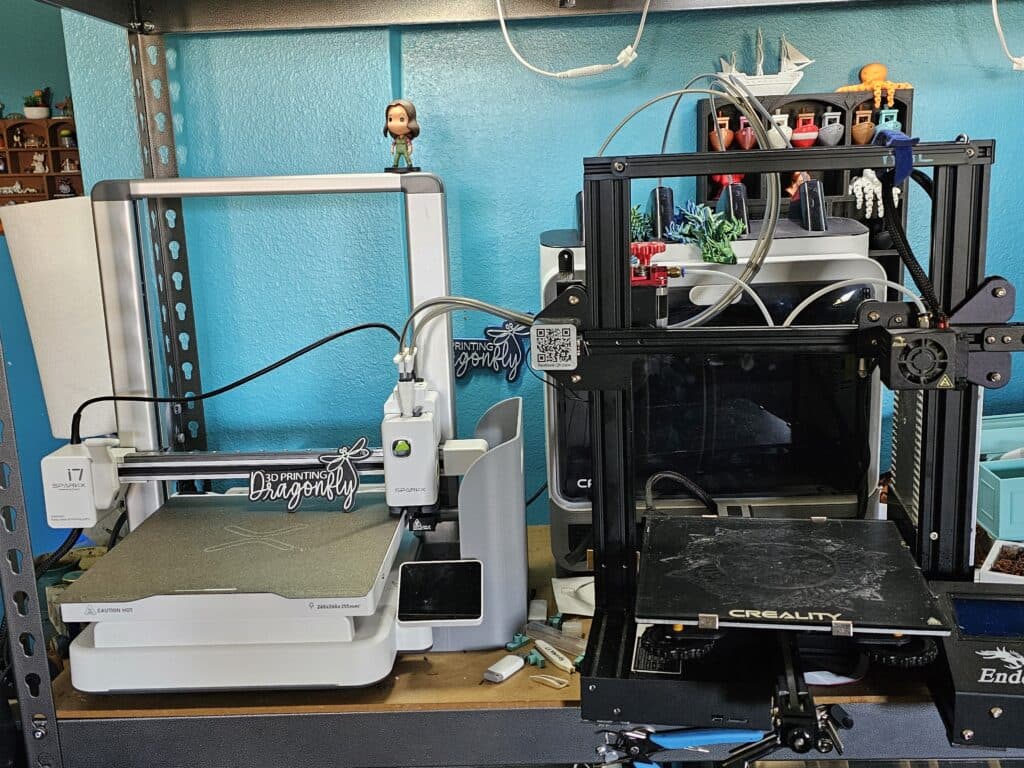
Even in my relatively short time with 3D printers, I have watched the technology evolve in a huge way. I started with the original Ender-3. No Pro, no Version 2, no extras. Just the OG Ender-3. And honestly, it intimidated me for a while.
It sat in its box in what was going to become my art studio until I finally worked up the courage to assemble it. I watched every assembly and setup video I could find on YouTube and spent hours making sure I had everything right. Back then, nothing on the original Ender-3 was automatic. You had to learn everything the hands-on way, especially bed leveling. I remember how confusing that felt at first, trying to understand how tiny adjustments could make the difference between a print sticking beautifully or turning into a tangled pile of spaghetti.
One thing you cannot really learn from YouTube is how that drag on the paper is supposed to feel when you are leveling the bed. That part was a lot of trial and error for me for weeks. It took me a while to really learn how to use the printer, and I think it was several months before I felt confident with it. The original Ender-3 had a 220 x 220 x 250 mm build volume and was a maximum print speed of 90 mm/s, though in real life, going above 50 mm/s was pushing your luck. While I never felt like I had to constantly tinker with it to get a good print, and I never went crazy doing upgrades the way a lot of people did, it definitely had a learning curve. That included figuring out slicing settings, which at the time felt like learning a whole second language.
But eventually, I got the hang of it and started getting reliable prints. Then in 2020, I got a CR-6 SE, and that felt like a huge leap forward.
The auto-leveling on the CR-6 SE was amazing. After wrestling with manual leveling on the Ender-3, having a printer that handled that part for me felt almost like cheating. I got two of them through Creality’s Kickstarter campaign and then bought a third a couple of years later. Those 3 printers became my workhorses for years. The CR-6 SE had a 235 x 235 x 250 mm build volume and a print speed of 100 mm/s. Compared to where I had started, it felt more polished and a lot easier to trust for daily use.
That reliability mattered more and more over time as I started taking commissions and doing prints for hire a few times a month. Those little jobs helped me pay for the printers and the CR-6 SE carried me right up until 2024, when I got the idea to launch my 3D printing business, 3D Printing Dragonfly. By then, they were not just hobby machines anymore. They were the printers I depended on. They helped bridge that space between learning a craft and realizing this could become a business. But I quickly realized I would need something bigger and faster to make it a viable business.
So in January 2025, I got an Ender-3 V3 Plus, and that was another one of those moments where I could really feel how far the technology had come.
I was blown away by how easy it was to assemble and by how much faster it printed. The Ender-3 V3 Plus has a 300 x 300 x 330 mm build volume and a top print speed of 600 mm/s, with 300 mm/s being more typical in normal use. A print that took 22 hours on the CR-6 SE took only 9 hours on the V3 Plus. That kind of difference changes how you think about production. It changes what feels possible in a day, in a week, and in a business. I bought a second one within two weeks, and those two printers quickly took over as the new workhorses as I launched my Etsy store and started filling orders.
What stood out to me most was not just the speed, but the way the machine reduced friction. Having Wi-Fi built in meant no more juggling SD cards and Creality Print was a huge improvement over Cura I had been using since 2018. It felt like less of my energy went into setup and settings, and more of it went into actually making things. When you are filling Etsy orders, that matters. You do not just want a printer that can move fast. You want one that makes the whole process feel more manageable. The Ender-3 V3 Plus did that for me.
As I built out my printer lineup through 2025, I added 2 more Ender-3 V3 Plus printers along with two other printers that felt like major milestones for different reasons.
The first was the Creality Hi Combo, which was my first multicolor printer. That alone made it feel like a whole new chapter. Until then, I had been thinking mostly in terms of speed, reliability, and production. The Hi Combo opened up more possibilities for my products. It gave me a new way to think about what I could make and how finished a piece could look straight off the printer. The Hi Combo has a 260 x 260 x 300 mm build volume and speeds up to 500 mm/s. The CFS multi-material system took some getting used to, but being able to use an entire filament spool through auto-refill was amazing.
Then I added the K2 Pro Combo, my first step into Creality’s flagship K series. You can feel a real difference in the machine. It feels more like a printer for commercial work – solid and reliable. While I mostly print PLA, its heated chamber opens the door to materials like ASA that I may eventually try. The K2 Pro Combo has a 300 x 300 x 300 mm build volume and print speeds up to 600 mm/s. It is one of those printers that makes you realize Creality is not only improving speed, but also moving into a more serious and more professional class of printer.
In 2026, Creality sent me their brand new SparkX i7, and that printer really made it clear how far consumer 3D printing has come.
The SparkX i7 has a 260 x 260 x 255 mm build volume and speeds up to 500 mm/s. It is designed to be easy right out of the box and to eliminate the intimidation I felt when I was first starting out with 3D printing, and it delivers on that in every way. Fully assembled out of the box, you can have it up and running within minutes. No more assembly. No more wondering if you tightened something too much or connected a wire wrong before you even start.
What impressed me most, though, was the print head design. This is where the SparkX i7 feels like a real user-focused leap forward. Changing the nozzle is no longer this annoying technical job where you end up removing a pile of screws while worrying about breaking delicate wires and connectors. Creality describes it as a quick-swap, no-tool hotend system, and in practice that difference is huge. Maintenance is actually easy. It does not feel intimidating. It feels like something designed by people who understand how frustrating older printer maintenance could be. Honestly, the Sparkx i7 is so easy a child can use it.
Dealing with clogs and filament issues is easier now too. It is just a matter of opening a lever and pulling out jammed filament with tweezers so you can get back to printing in minutes instead of doing a long tear-down. That may sound like a small thing, but anyone who has spent too much time taking apart an older print head knows it really is not. The SparkX i7 replaces that old “take half the machine apart and hope for the best” feeling with something much more practical. Open the lever. Handle the issue. Move on. No more having to be part technician just to use a 3D printer. I hope to see this print head evolve more and into future Creality models.
Looking back, I can see each Creality printer marking a different stage in my life with 3D printing.
The Ender-3 was the beginning: exciting, inspiring, and a little intimidating. The CR-6 SE gave me confidence and consistency. The Ender-3 V3 Plus helped me step fully into production and business mode. The Hi Combo opened the door to multicolor printing. The K2 Pro Combo gave me my first taste of Creality’s flagship professional class. And the SparkX i7 feels like a glimpse of where desktop 3D printing is going next, toward machines that are not just faster, but easier to use. To a world where the average person can use a 3D printer.
That is probably the biggest change I have felt over the years. In the beginning, using a 3D printer felt like learning how to work the machine. Now, you can let the machine do the work and learn how to create anything you imagine.